THE-LENS@THE-LENS
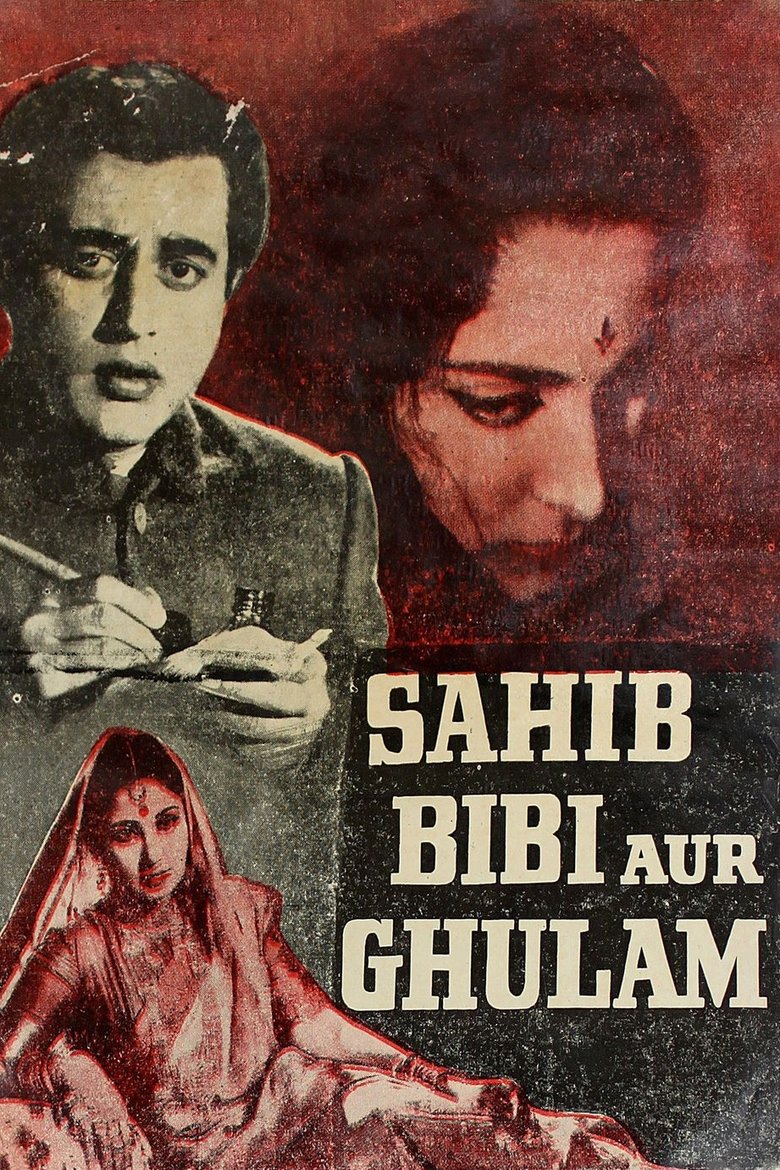
# ***Sahib Bibi Aur Ghulam***
Directed by \[Abrar Alvi\], produced & co-directed by \[Guru Dutt\], who also co-stars in it alongside \[Meena Kumari\], \[Rehman\], and \[Waheeda Rehman\].
**Review by Dr Usman Latif Khawaja**
### **Meena's Melancholic Masterpiece**
It is rather bizarre that the best-ever adaptation of a book into a cinematic masterpiece in Indian cinema is black and white, but then it is notoriously difficult to achieve that amazing feat. Yet the combined genius of Abrar Alvi and Guru Dutt was able to accomplish that true miracle in this mesmerizingly poetic but pragmatically realistic version of the Bimal Mitra Bengali novel in 1962.
This is as much a social documentary on the degenerate debauchery of the Indian aristocracy, set in the era of the British Raj, which works as a socio-political satire on their lackadaisical indifference to Indian colonisation, as well as an enthralling human drama about relationships that will haunt you forever.
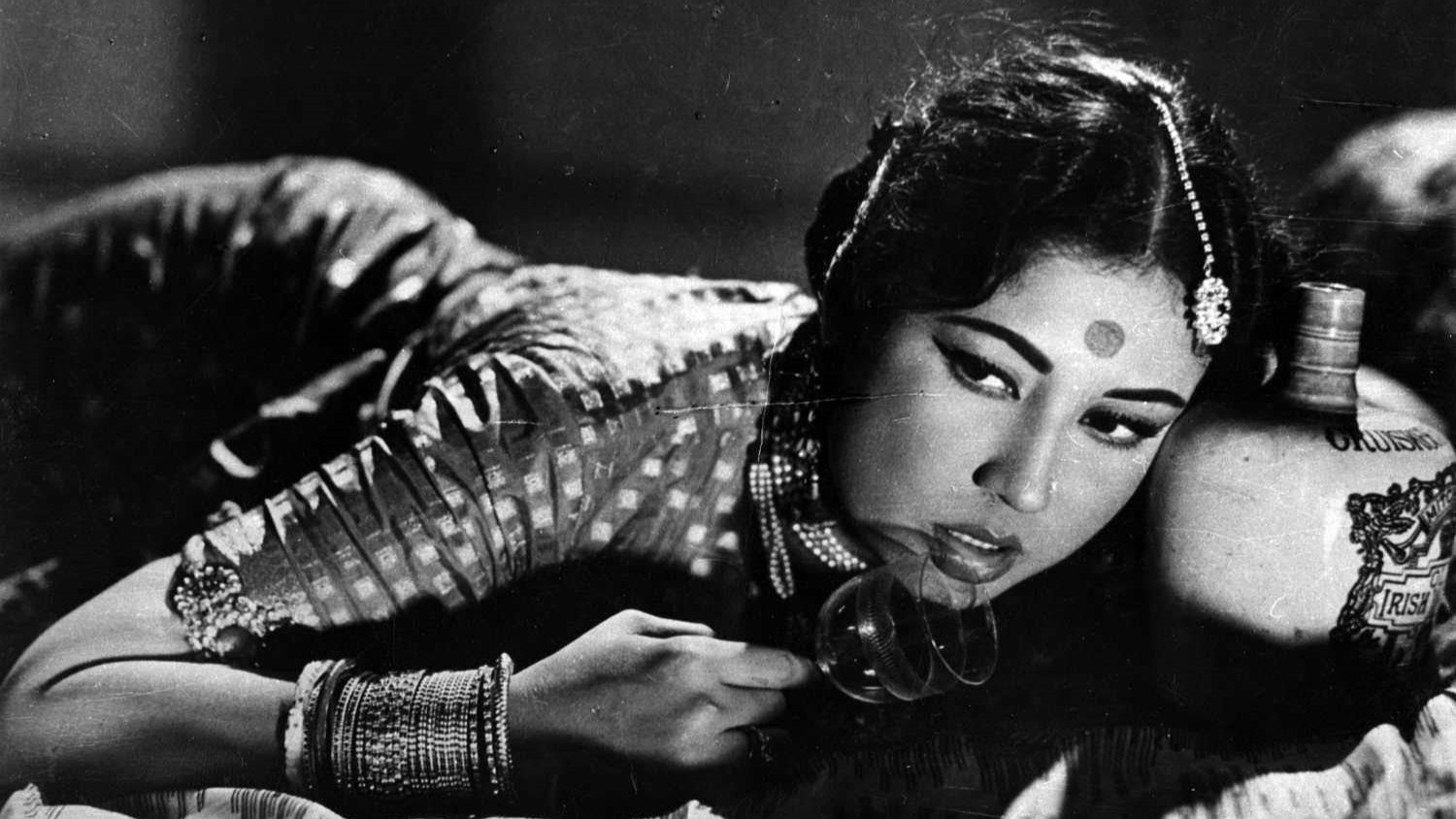
The three principal characters are the rather wayward, womanising landlord husband \[Rehman\], his enchantingly beautiful, celestially loyal wife, Chhoti Bahu \[Meena Kumari\], and the young man Bhootnath \[Guru Dutt\], a young country bumpkin recently arrived in Calcutta as an aspiring architect, who becomes her clandestine liaison as she desperately tries to conspire and win her consort back from the charms of dancing girls, gambling and alcoholic evils.
The drama unfolds as a flashback, as the young man, now a mature architect, is in charge of digging the ruins of the dilapidated palace where he met Chhoti Bahu a decade ago. As he reminisces over the past, the script fluidly pours over the colonial evils and malpractices prevalent during a dark chapter in Indian history.
It is rather pathetic that Chhoti Bahu becomes a symbol for Indian feminism. As the fiercely loyal wife, she will stop at nothing to be neglected criminally by her husband's loquacious antics, even if it means indulging in alcohol and turning herself into a dancing girl to attract him. But his indifference is enigmatic, as he accuses her ways as corrupt but sees himself as righteous in his drunken orgies every night in the mansion itself.
The young architect is in a platonic relationship with the aristocrat's wife, which is misunderstood with disastrous results, culminating in one of the greatest tragic endings that will forever linger in your memory.
While the rest of the cast excel as well, with Waheeda Rehman playing the fanciful young girl infatuated with the student architect, the movie solely belongs to the tremendously sensitive yet melancholically touching portrayal of a young, rebellious, alcoholic wife by Meena Kumari. This is the penultimate role for any actress in the world, and Meena displays her histrionics as never before. She makes Bette Davis and Hepburn look like pedestrians with her emotive nuances, combined with a fragile beauty which is unique to only Indian women.
Thus, this is not just a dramatic satire on the evils of the infamous landlords, but also defines the iconoclastic values of Indian womanhood, and who better than the eternally green Meena Kumari to portray this great role?
The only flaw from the point of view of Western audiences could be the haunting soundtrack by Hemant Kumar, melodiously sung by Geeta Dutt and Asha Bhosle, which adds to its Indian soul of this great epic, but might interfere with the perfection of the narrative for foreign audiences.
The great themes of sexual exploitation and Indian moral degeneration, which led to colonisation, are immortalised in this gorgeously framed and crisply edited movie, which symbolises the tragic past yet beckons the future with an optimism only the great Indian cinema created in its most creative days.
The fable of the king, queen and slave, as the name literally translates, is impeccable and immaculately sacred, and it will be a blasphemy for anyone from today's era to even go near this genuine masterpiece of Indian cinema.