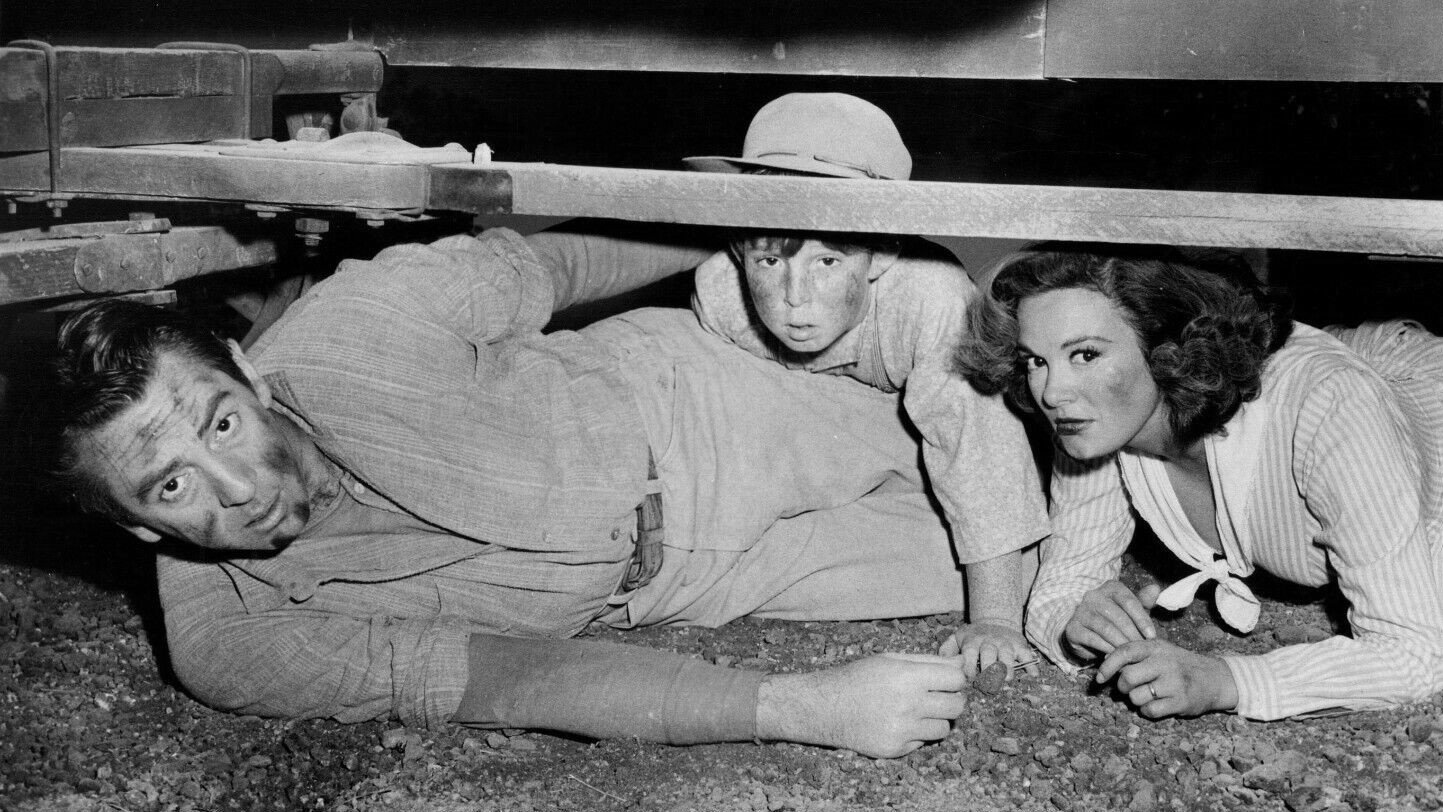
Notorious outlaw Clay Anderson and gang rob the town bank and flee in separate directions. Riding hard, Clay's horse goes lame and he is forced to pull-up at a nearby farm. He soon discovers that the place belongs to local preacher Hollis Jarret, his new wife, and a son from a previous marriage. Clay, posing as a weary traveler, tries to insinuate himself into a secure hideout, but the reverend isn't fooled. He agrees to allow Clay to remain at the farm for a few days, but his motive isn't the preservation of his family's safety. Hollis reasons that, with time, patience and a lot of faith, he can convince the outlaw to turn over a new leaf. But Clay's criminal tendencies may run deeper than the preacher had imagined

There is a little of the "Shane" (1953) to this western as escaping bank robber "Clay" (Skip Homeier) finds his horse gone lame on the outskirts of a farm owned by a preacher and his family. As he approaches an half-built church, he meets the young "Dodie" (Stephen Wootton) and his dog and then his stepmother "Peg" (Patricia Medina) before finally the pastor himself (Macdonald Carey). Despite his pretence that he's a successful traveller, the minister is less than convinced - but instead of sending him on his way, he sees an opportunity to convert him from his hitherto lawless ways. That might be easier said than done, though, as "Clay" and his partners - who had skedaddled in a different direction after their latest bank job - still have unfinished business and there's still a pursuing posse to consider, too. Add to that, there is the simple fact that even though he has taken a bit of a shine to the engaging young "Dodie" and there is a certain smouldering going on between him and "Peg", you are never far from expecting him to dispose of his naive hosts when the time is right. Now this is where the wheels of menace rather disappointingly come off for me, but it's also where Carey steps up to the plate in an unexpected fashion as his butter-wouldn't-melt character assumes something far more interesting and conflicted. Sure, he is concerned for the safety of his family but there is also something borderline maniacal about his behaviour at times - a religious zealouness tempered by something much deeper. For "evil" to win, even tangentially, was simply not on the cards and as the film builds to it's conclusion there is a certain predictability to it, but along the way the plot challenges a few of the more routinely presented stereotypes of this genre - those epitomised by the undercooked role given to a Medina who tries to make more of her role, but who is limited by opportunity rather than skill. Religion features prominently here and that, too, offers us two sides of a coin to consider what influences human behaviour and what distinguishes right from wrong. Perhaps the fact that nobody here is what you might describe as an A-lister helps focus it more on the story, and for a good part of that this is quite a decent watch.